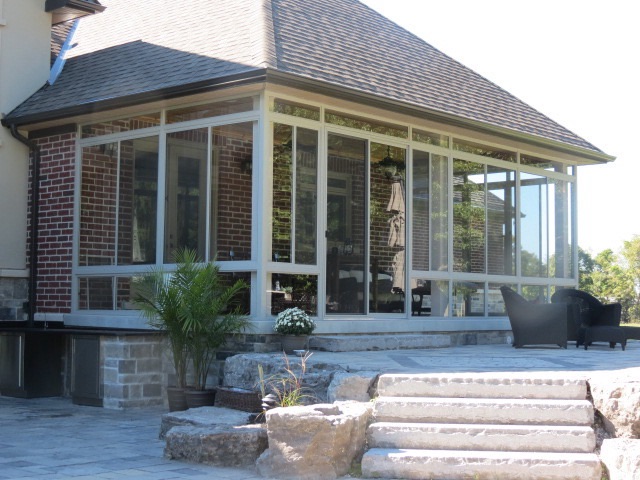
A leaking sunroom or solarium roof is one of those problems that feels manageable at first — a drip here, a water stain there — and then suddenly you’re looking at warped flooring, mold in the walls, and corrosion eating through the frame. Catching it early and understanding exactly where it’s coming from is everything.
This guide walks through every stage of a solarium roof leak: how to spot it before it becomes obvious, where leaks actually originate (which is rarely where water first appears), how sealant and flashing failures work, and when the right call is bringing in a professional rather than reaching for a caulking gun yourself. We cover all the situations our team encounters across Toronto, Mississauga, Brampton, Vaughan, and the wider GTA.
What to look for before the damage becomes serious
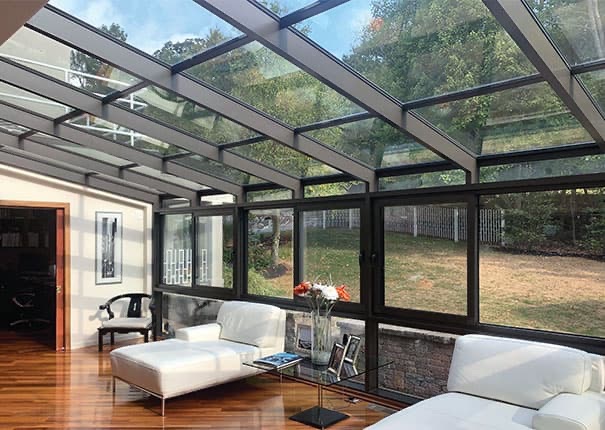
The tricky thing about a leaking sunroom or solarium roof is that water rarely appears exactly where it enters. It travels along frame channels, glass edges, and structural members before dripping or pooling somewhere inside — sometimes several feet away from the actual breach. That’s why spotting the early warning signs matters more than waiting for an obvious drip.
These are the signals to watch for, in rough order of urgency:
Don’t rely on the “raindrop test.” Many solarium roof leaks only appear during specific wind-driven rain conditions or after a long dry spell when cracks have fully opened. If you see any of the signs above — even without active dripping — treat it as a confirmed leak and investigate the source promptly.
Alumwave Glazing provides leaking sunroom repair and full solarium repair services across Toronto and the GTA — free inspection, same-day emergency response.
Where leaks actually start — and why they appear somewhere else

Understanding where solarium roof leaks originate is the key to fixing them permanently rather than chasing water stains around the interior. The gap between where a leak appears inside and where it actually enters the structure can be 3–4 feet or more — water travels the path of least resistance through frame channels and glass laps before it drops.
Here are the most common entry points our team identifies during inspections across Richmond Hill, Markham, Vaughan, and Aurora:
| Leak Location | Most Common Cause | How Often |
|---|---|---|
| Ridge line (roof peak) | Failed ridge cap sealant, lifted flashing, debris in ridge channel | Very Common |
| House wall junction | Failed step flashing, cracked caulk at house connection, no weep holes | Very Common |
| Glass lap joints | Dried glazing tape, failed secondary seal on overlapping glass panels | Very Common |
| Eave gutters & drainage channels | Blocked drainage causing water to back up into frame joints | Common |
| Frame corner joints | Thermal movement separating joints over years of freeze-thaw cycling | Common |
| Skylight / vent surrounds | Failed skylight flashing or dried perimeter sealant | Common |
| Individual glass panels | Stress fractures from thermal expansion, hail, or installation stress | Less Common |
Start your inspection at the ridge line and wall junction. These two spots are responsible for the majority of solarium roof leaks we see across the GTA. Look for cracked or missing sealant, lifted flashing, or gaps where metal meets glass or masonry.
One pattern worth knowing: in Newmarket, Barrie, and Guelph where winters produce significant ice damming, leaks that only appear in late winter or early spring are often caused by meltwater backing up behind ice dams at the eave — not from a failure in the glass or sealant. The fix involves clearing the drainage and adding a membrane under the eave panels, not just resealing the glass.
Why caulk and flashing fail, and what proper repair looks like
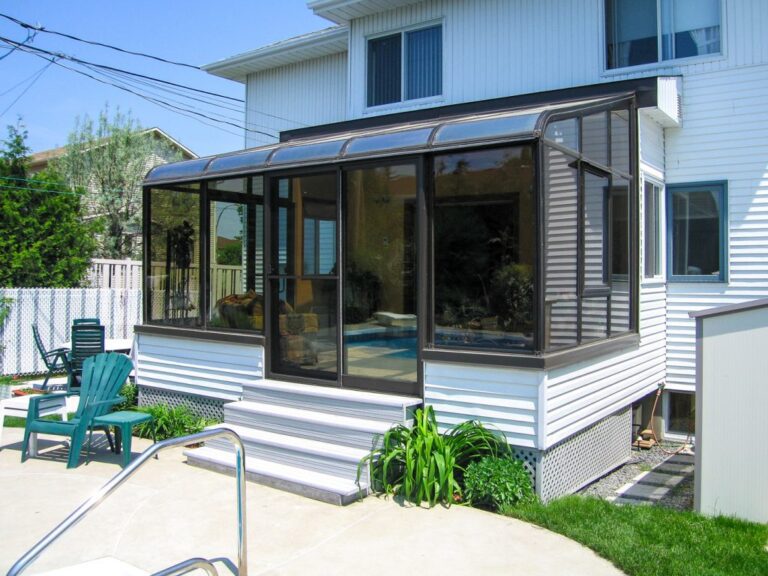
If you asked our team what causes the majority of leaking sunroom and solarium roof calls across Toronto, Mississauga, and Brampton, the answer would be the same almost every time: failed sealant, failed flashing, or both. These are the waterproof barrier between your living space and the outdoors — and both have a finite lifespan.
Silicone and polyurethane sealants are typically rated for 10–15 years under normal conditions. Ontario’s climate accelerates that significantly — extreme cold causes sealant to contract and crack, UV exposure breaks down the polymer chains, and the constant expansion and contraction of aluminum frames works the bead loose over years.
The bead has physically cracked or pulled away from the glass or frame. Water enters immediately during rain. Repair needed now.
The bead has completely fallen out or was never applied properly. Open gap directly to the interior. Urgent.
Sealant has lost flexibility and become rigid. Will crack under the next thermal movement. Repair before the next season.
UV degradation has broken down the surface. The bead is weakening even if not yet cracked. Monitor closely.
This is where most DIY leaking sunroom repairs go wrong. Applying new sealant over old, failed sealant — called “cap and cover” — never works long-term. The old material continues to move and fail underneath. Proper resealing means:
Mechanical scraper removal of all existing material from the joint — not just cutting the surface.
Glass and aluminum surfaces are cleaned and primed before any new sealant is applied. Skipping primer is the single most common cause of premature sealant failure.
Silicone for glass-to-glass and glass-to-metal joints; polyurethane for glass-to-masonry; structural sealant at load-bearing junctions.
Too thin and it won’t accommodate movement; too thick and it skins over before curing through.
Typically 24–72 hours depending on temperature and humidity. Rain on uncured sealant ruins the job.
Flashing at the wall junction, ridge, and around vents is a physical metal barrier — not just a sealant. It fails through corrosion, fastener failure, thermal lifting, and improper original installation. Many leaking solarium roofs in Hamilton, Milton, and Guelph that look like a sealant problem are actually a flashing problem — the flashing has lifted at the top edge, allowing wind-driven rain to enter behind it.
Applying caulk over lifted flashing doesn’t fix the flashing. Water will work its way behind the caulk, freeze, and push the flashing further away from the wall. Proper repair means removing the lifted section, correcting the fastening, and then sealing the overlap — in that order.
Worth flagging specifically: in solariums attached to brick homes — common in older Mississauga and Brampton neighbourhoods — the step flashing where the roof meets brick often fails when mortar joints around the embedded flashing deteriorate. The repair involves tuckpointing the brick, not just resealing the glass side.
What’s involved in repairing or replacing solarium roof glass
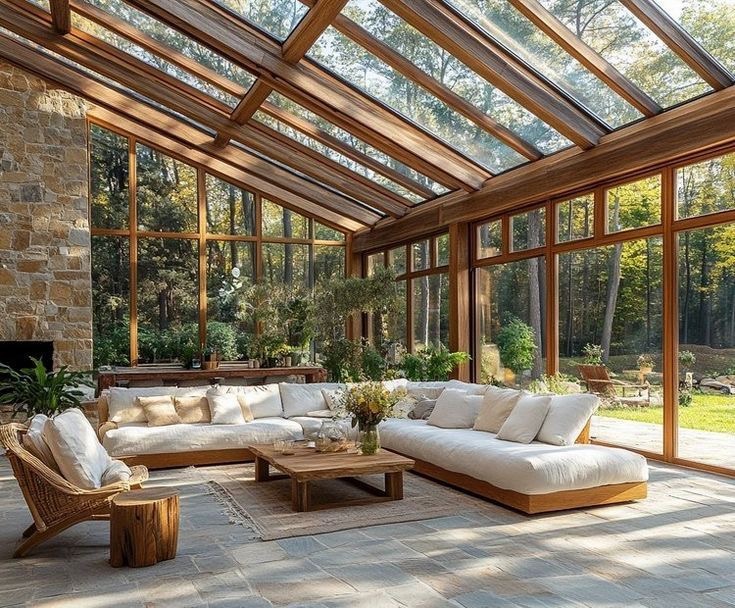
When sealant and flashing are intact but a leak persists, the glass panels themselves are usually the source. Solarium roof glass takes more punishment than wall panels — direct UV, rain impact, snow load, and the steepest thermal cycling all happen at the roof.
A thin branching crack without an obvious cause is usually a stress fracture — the glass was loaded unevenly during installation, the frame is deflecting, or a panel is slightly too large and being compressed at the edges during thermal expansion. These cracks let water in and grow with each temperature cycle.
In Markham, Vaughan, and Richmond Hill, we see many 15–20 year old solariums with stress fractures in the original glass because older installations used annealed (non-tempered) glass. Current Ontario Building Code requires tempered or laminated safety glass for overhead applications — every replacement panel we install is code-compliant.
Shatters into small, safe pieces. Required by code for most overhead panels. Typical lead time 2–5 days for custom sizes.
Stays in place when broken — preferred for overhead panels over living areas where falling glass is a concern.
Reduces solar heat gain and improves winter insulation — often chosen as an upgrade during a repair job.
For double or triple-pane panels — only the failed glass unit is replaced, not the frame. Most cost-effective for isolated failures.
Many older solariums in Pickering, Newmarket, and Aurora were built with polycarbonate or acrylic twin-wall panels. These yellow, become brittle, and lose light transmission over 10–15 years. Cracked polycarbonate can sometimes be temporarily sealed, but permanent repair means replacing the full panel. When replacing, many homeowners upgrade to glass — the weight difference requires checking frame load capacity first, which is part of our assessment.
Victorian and curved-eave solariums need curved glass panels that require specialist fabrication — most glazing companies don’t stock or source these. If you have a heritage-style conservatory in Toronto‘s older neighbourhoods or in Oakville or Burlington, replacement glass is available — it just requires a proper template measurement to get the curve profile exactly right before fabrication begins.
You don’t always need to replace the whole panel. For IGU failures where only the seal has failed but the glass is intact, we can replace just the glass unit inside the existing frame — keeping your original frame and significantly reducing cost. We assess this on every job before recommending full panel replacement.
We supply and install tempered, laminated, Low-E, and curved glass for all solarium types. View our sunroom and solarium repair services or call us directly.
The maintenance routine that keeps solarium roofs watertight year after year
Most solarium roof leaks aren’t sudden failures — they’re the result of years of gradual deterioration that was never caught. A simple annual inspection routine, timed for early spring (after winter freeze-thaw) and early fall (before winter), catches the vast majority of problems when they’re still cheap to fix.
Check for damage from winter freeze-thaw. Clear gutters of debris. Ideal time for full sealant inspection in Barrie, Guelph, and Newmarket.
Confirm spring repairs have held. UV peaks — inspect for sealant discolouration in older Toronto and Mississauga solariums.
Most critical inspection period. Clear leaves from drainage. Address sealant issues before freeze-thaw in Hamilton, Burlington, Oakville.
Remove heavy snow loads promptly in Barrie and Guelph. Watch for ice dam formation. Note any new drips to trace in spring.
Professional inspection every 2–3 years. A trained eye catches what a homeowner walk-through misses — hidden frame corrosion, early glazing tape failure, small stress fractures. An inspection that costs a few hundred dollars often prevents a repair bill that’s ten times larger.
How to choose the right contractor and what a proper repair involves
Some leaking sunroom repairs are within a determined homeowner’s reach — replacing a short section of worn caulk on an accessible joint, clearing a blocked drainage channel, or replacing a door weatherstrip. But there’s a clear line beyond which DIY repair makes the situation worse, not better.
We systematically trace the water path from where it appears inside back to where it enters — not just reseal the obvious spots. We document every finding before recommending any work.
A clear, itemised quote covering every repair point identified. No surprises. We explain repair vs. replacement for each component honestly.
All failed sealant fully removed. Glass and frame surfaces cleaned and primed correctly — the step most contractors skip.
Each repair point addressed in the correct sequence: structural before cosmetic, drainage before sealing. Replacement glass installed to code.
We test the repair before leaving — either with water application or by returning after the next rainfall to confirm the leak is fully resolved.
24/7 emergency response available. If your solarium roof is actively leaking during a storm and you need same-day help across Toronto, Mississauga, Brampton, Hamilton, or anywhere in the GTA — our 24/7 emergency glass repair service is available around the clock. Call 905-251-1205.
Alumwave Glazing provides professional sunroom and solarium repairs and leaking sunroom roof repair across Toronto, Mississauga, Brampton, Vaughan, Markham, Oakville, Burlington, Hamilton & all GTA. Free estimates. No patches — permanent fixes.
Serving homeowners for leaking sunroom repair across:
Alumwave Glazing Inc. — 448 Gibraltar Drive Unit 9, Mississauga, ON L5T 2N8 · 905-251-1205 · Mon–Fri 8am–4pm, Sat–Sun 8am–12pm · info@alumwave.com